Foundation Repair Cost in Marietta & Cobb County, GA (2026 Price Guide)
How much does foundation repair cost in Marietta, GA in 2026?
Foundation repair in Marietta and Cobb County typically costs $3,500 to $25,000+ overall, but most homes never reach the top. Crack injection runs $300β$3,000, slab leveling $600β$2,500, and helical or push piers $1,400β$3,500 per pier. Only a free on-site inspection produces an exact, binding number.
"Foundation repair" covers everything from sealing one hairline crack to underpinning a sinking wall with a dozen steel piers, so the price spread is wide. Across Marietta, East Cobb, Smyrna, Kennesaw, Acworth, and Powder Springs, the overall range homeowners should budget for is $3,500 to $25,000+ β but the majority of jobs land well below the ceiling, in the low-to-mid thousands, once the actual problem is diagnosed.
Marietta Foundation Repair is a disclosed lead-referral service, not a contractor. We do not perform work, set prices, or send out crews. We connect Cobb County homeowners with one vetted, licensed, and insured local foundation repair partner who handles the inspection, the diagnosis, and the written quote. The homeowner pays us nothing; the local partner pays a referral fee.
The per-method tables below use real Cobb County price ranges so you can budget honestly before anyone visits. Treat them as estimates, not quotes β every house, soil pocket, and failure pattern is different, which is why no honest number can be given by phone. When you are ready, schedule a free on-site inspection to turn these ranges into an exact figure, or start with the foundation repair methods overview.
What does foundation repair cost by method in Cobb County?
By method, expect roughly: crack injection $300β$3,000; slab leveling $600β$2,500; helical or push piers $1,400β$3,500 per pier; bowing-wall carbon-fiber straps $1,750β$6,000; crawl space encapsulation $5,000β$12,000; and basement waterproofing $2,000β$10,000. The on-site inspection is always free and turns these estimates into a real number.
Most homeowners only need one of these repairs, not all of them. The table below is the fastest way to match your symptom to a realistic Cobb County budget. Each range reflects materials, labor, and access typical of Piedmont red clay homes β from post-WWII brick ranches to 1990s basement subdivisions. Click through to any method page for how the work is actually performed.
These figures are budgeting estimates that require an on-site inspection to confirm. The single biggest variables are how much of the foundation is affected (severity) and how many support points it needs (pier count) β both covered in the next sections.
- Crack repair / injection: $300β$3,000 β cosmetic epoxy or polyurethane at the low end; structural cracks with carbon-fiber reinforcement at the high end. See foundation crack repair.
- Slab leveling (polyurethane foam or mudjacking): $600β$2,500 typical β lifting a settled slab-on-grade section back to grade. See slab foundation repair.
- Helical or push piers: $1,400β$3,500 per pier; most homes need 3β12 piers; full underpinning jobs run $5,000β$30,000+. See helical pier installation.
- Bowing wall / carbon-fiber straps: $350β$1,000 per strap; $1,750β$6,000 total (steel wall anchors cost more). See bowing wall repair.
- Crawl space encapsulation: $5,000β$12,000 β sealed vapor barrier, drainage, and dehumidification. See crawl space encapsulation.
- Basement waterproofing: $2,000β$10,000 β interior drains, sump systems, and exterior water control. See basement waterproofing.
- Foundation inspection: FREE, no obligation. See foundation inspection.
How much do helical and push piers cost per pier?
Helical and push piers cost $1,400 to $3,500 per pier in Cobb County, with most settling homes needing 3 to 12 piers. A focused corner repair may use just a few piers, while a full underpinning job runs $5,000 to $30,000+. Pier count depends on how much foundation has dropped and how deep stable soil sits.
When a foundation has actually settled β sunk into the shifting clay β the structural fix is underpinning with galvanized steel piers. Pricing runs $1,400 to $3,500 per pier, and the typical Marietta home uses 3 to 12 piers, putting a full underpinning project in the $5,000 to $30,000+ zone. Helical piers screw into load-bearing soil and suit lighter slab-on-grade ranches; push (resistance) piers are driven to refusal under heavier homes.
Pier count is the single biggest line item, and it is not arbitrary. The contractor maps where the home has dropped, then spaces galvanized steel piers to transfer the load to stable strata below the active red-clay zone. A settled garage corner in Smyrna might need 3β5 piers; a full sinking wall in an East Cobb subdivision can need a dozen. That is why per-pier pricing exists instead of a flat fee.
Underpinning is what most people picture when they think "foundation repair," and it anchors the upper end of the overall $3,500β$25,000+ range. Learn how the process works on our helical and push piers page, or see the bigger picture on foundation repair methods.
What do crack injection, slab leveling, and waterproofing cost?
Crack injection runs $300β$3,000 (cosmetic epoxy or polyurethane low, structural plus carbon-fiber high). Slab leveling with polyurethane foam or mudjacking runs $600β$2,500. Basement waterproofing runs $2,000β$10,000. These mid-range repairs solve most Cobb County foundation problems without the cost of full underpinning.
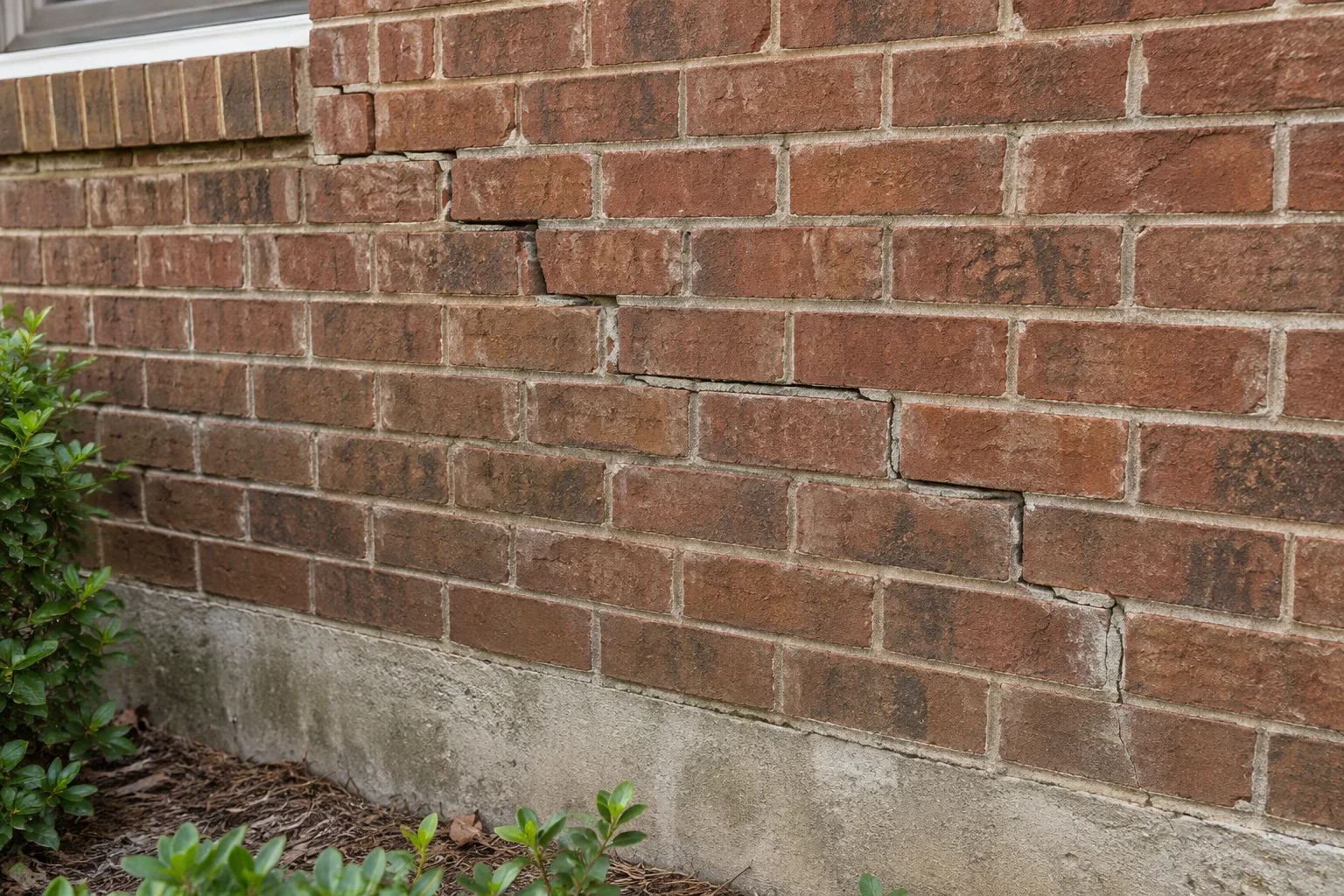
Crack injection is the lowest-cost foundation service at $300 to $3,000. Cosmetic shrinkage cracks sealed with epoxy or flexible polyurethane sit at the low end; structural cracks needing carbon-fiber reinforcement reach the high end. Injection is the right call only when the crack is not moving β if your stair-step brick cracks keep widening, the cause is settlement and piers are the real fix. See crack and seepage repair.
Slab leveling β polyurethane foam injection or traditional mudjacking β runs $600 to $2,500 and lifts a settled slab-on-grade section back to grade through dime-sized ports. Lightweight foam resists washout in Marietta's moisture-cycling clay and cures in minutes; mudjacking costs less but adds weight onto the same soil that failed. Details on slab foundation repair.
Basement waterproofing runs $2,000 to $10,000 for interior drains, a sump system, and exterior water control. Because poor gutter and grading drainage is the silent number-one contributor to foundation movement here, waterproofing is frequently bundled with a structural repair so the clay never re-saturates. See basement waterproofing.
What does it cost to fix a bowing wall or encapsulate a crawl space?
Bowing-wall reinforcement with carbon-fiber straps costs $350β$1,000 per strap, or $1,750β$6,000 total; steel wall anchors cost more. Crawl space encapsulation runs $5,000β$12,000 for a sealed vapor barrier, drainage, and dehumidification. Both are common in 1990s Cobb County subdivisions with basements and crawlspaces.
When lateral soil pressure pushes a basement or block wall inward, carbon-fiber straps bonded vertically with structural epoxy lock it in place at $350 to $1,000 per strap, typically $1,750 to $6,000 for the wall. Carbon fiber suits walls bowed roughly two inches or less; severely bowed walls need galvanized steel wall anchors, which cost more because they require exterior excavation. See bowing wall repair.
Crawl space encapsulation runs $5,000 to $12,000 and seals the crawlspace with a heavy polyethylene vapor barrier, drainage corrections, and often a dehumidifier β protecting the wood girders and joists above from the rot that softens floors. It is one of the most effective long-term moisture fixes for the basement-plus-crawlspace homes common in Kennesaw and Acworth. See crawl space encapsulation.
These pressure and moisture problems trace back to the same source: 50+ inches of annual rain saturating backfill against 1990s subdivision walls during the spring storm peak. Pairing structural reinforcement with moisture control β covered on pier-and-beam and crawlspace repair β addresses both the symptom and the cause.
Why is foundation repair more common and pricier in Marietta?
Marietta sits on Piedmont red clay (Cecil soil series) that swells when wet and shrinks 10β15% in volume during droughts β roughly twice the seasonal soil movement of most US regions. That aggressive clay, plus 50+ inches of annual rain and moisture-hungry oak roots, drives more settlement and deeper piers, which raises severity and cost.
The biggest cost driver in Cobb County is the ground itself. Marietta, East Cobb, Kennesaw, and Acworth all sit on Piedmont red clay of the Cecil soil series β an expansive clay that swells when wet and shrinks roughly 10β15% in volume during dry spells and drought, causing differential settlement. That is about twice the seasonal soil movement of most of the country, and it is the number-one reason foundations move here.
The damage follows a calendar. Clay swells in the wet spring (MarchβMay) and shrinks in the dry late summer and fall (AugustβOctober), and movement spikes both after a drought and after heavy rain. Atlanta takes 50+ inches of rain a year in spring and fall storm peaks, so the clay is repeatedly soaked and baked. Add mature oak roots pulling moisture from the same soil and the poor gutter and grading drainage that silently feeds most failures, and you get deeper, more variable settlement than a contractor would see in stable sandy or rocky regions.
Deeper, more active clay means piers must be driven farther to reach stable soil β which can push both per-pier cost and pier count upward versus other regions. For the full mechanics, see why foundations crack in Cobb County, and for the symptoms that prompt a quote, signs you need foundation repair.
What factors change my final foundation repair quote?
Beyond method, your quote moves with the severity of movement, the number of piers, site access, soil and drainage conditions, foundation type, and even the season you book. A buried slab corner with no crawlspace access costs more to reach than an open basement. The free on-site inspection prices each of these.
The headline ranges narrow into a real number once the contractor weighs the factors below. None can be assessed remotely, which is why a price quoted sight-unseen is a guess at best β and a red flag worth checking against our guide to vetting a Cobb County contractor.
Marietta's mixed housing stock matters here too: post-WWII slab-on-grade brick ranches, 1990s basement-plus-crawlspace subdivisions, and newer post-tension slab infill each fail differently and demand different repair approaches, which directly affects labor and materials.
- Severity of movement β a hairline crack versus a two-inch settled corner are different jobs entirely.
- Number of piers β the primary cost lever, set by how much foundation has dropped (3β12 piers at $1,400β$3,500 each).
- Site access β open basements are cheap to work in; tight crawlspaces, finished interiors, or piers under a driveway add labor.
- Soil and water β depth to stable Cecil clay and active drainage problems change pier depth and may add waterproofing.
- Foundation type β pier-and-beam, slab-on-grade, post-tension, and basement walls each call for different methods and materials.
- Season β booking during the wet spring or dry fall, when the red clay is at its movement extremes, often reveals the truest picture.
Does homeowners insurance cover foundation repair in Georgia?
Usually not. Standard Georgia homeowners policies rarely cover foundation damage from settling, expansive clay, or poor drainage, because insurers classify it as gradual earth movement rather than a sudden covered peril. Damage from a burst pipe or other covered event sometimes qualifies. Always confirm with your own carrier.
This is the part that surprises most homeowners: standard insurance rarely covers foundation settling. Carriers treat shifting expansive clay, normal settlement, and drainage-related movement as gradual "earth movement," which is typically excluded. The slow seasonal swelling and 10β15% dry-season shrinking of Piedmont red clay is exactly the cause policies are written to avoid paying for.
There are narrow exceptions β for example, when foundation damage stems directly from a covered sudden event such as a burst plumbing line. Coverage varies by policy and insurer, so read your declarations page and call your agent before assuming anything. Marietta Foundation Repair does not provide insurance advice; we simply flag what Cobb homeowners commonly run into. For the full breakdown, see our Georgia foundation repair insurance guide.
Because coverage is the exception rather than the rule, most homeowners plan to pay out of pocket, and many local contractors offer financing. Ask about terms during your free inspection so you can compare the monthly cost against the repair scope.
Why do I need a free on-site inspection to get a real price?
An accurate foundation quote requires measuring elevation drops, identifying the failure type, checking soil and drainage, and counting the support points needed β none of which can be done by phone. The contractor we connect you with performs a free, no-obligation on-site inspection, consistent with IRC Section R401 residential foundation standards.
A trustworthy estimate comes from data, not guesswork. During the free on-site inspection, the local partner takes elevation readings across the floor, traces cracks to their cause, checks gutter and grading drainage, evaluates the Cecil clay, and identifies the foundation type before counting how many piers β if any β the structure actually needs. Residential foundation work is governed by IRC Section R401, and a proper inspection documents conditions against that standard.
Watch for these warning signs before you book: stair-step brick cracks, doors and windows that stick, sloping or bouncy floors, drywall cracks fanning out over doorways, basement or crawlspace seepage, and gaps opening at trim or where the floor meets the wall. Catching them in the wet spring or dry fall β when the clay is at its movement extremes β often reveals the most. The warning-signs guide covers each in detail.
Marietta Foundation Repair connects you with one vetted, licensed, insured local partner serving Marietta, East Cobb, Smyrna, Kennesaw, Acworth, and Powder Springs. The inspection is free, the homeowner pays nothing, and you receive an exact written quote. Schedule your free inspection to turn the ranges on this page into a real number.
Frequently asked questions
How much does foundation repair cost in Marietta, GA?
Overall foundation repair in Marietta and Cobb County runs $3,500 to $25,000+, but most homes cost far less. By method: crack injection $300β$3,000, slab leveling $600β$2,500, helical or push piers $1,400β$3,500 per pier (3β12 piers typical), bowing-wall straps $1,750β$6,000, crawl space encapsulation $5,000β$12,000, and basement waterproofing $2,000β$10,000. These are budgeting estimates; the free on-site inspection produces the real number.
Can you give me a foundation repair price over the phone?
No, and you should be cautious of anyone who does. Foundation pricing depends on elevation drops, the failure type, soil and drainage, foundation type, and pier count β all of which require an on-site visit. The ranges on this page are for budgeting only; the free inspection from the vetted local partner produces the real, written number with no obligation.
How many helical piers will my Marietta home need, and what do they cost?
Most Cobb County homes that require underpinning use 3 to 12 galvanized steel piers at $1,400β$3,500 each, putting a full underpinning job at $5,000β$30,000+. The exact count depends on how much foundation has settled and how deep stable soil sits below the active red-clay zone. The free inspection maps the settlement to set the count and per-pier price.
Is crack injection enough, or do I need piers?
Crack injection ($300β$3,000) seals non-moving cosmetic or leaking cracks with epoxy or polyurethane, sometimes with carbon fiber. If cracks keep widening, doors stick worse each season, or floors slope, the movement is active and underpinning with piers ($1,400β$3,500 each) is the real fix. The free inspection determines which path your home actually needs.
Will my homeowners insurance pay for foundation settling in Georgia?
Usually not. Standard Georgia policies rarely cover damage from settling, expansive clay, or drainage, treating it as gradual earth movement. Damage from a sudden covered event, like a burst pipe, sometimes qualifies. Coverage varies, so confirm with your own insurer. See our Georgia foundation repair insurance guide for the full breakdown before assuming anything.
Why is foundation repair more common in Marietta than in other areas?
Marietta sits on Piedmont red clay (Cecil soil series) that swells when wet and shrinks 10β15% in volume during droughts β roughly twice the seasonal soil movement of most US regions. Combined with 50+ inches of annual rain, moisture-hungry oak roots, and poor drainage, that aggressive clay drives more frequent and deeper foundation movement here, which can raise both repair frequency and cost.
Does the free inspection put me under any obligation?
No. Marietta Foundation Repair is a disclosed lead-referral service, not a contractor, so the homeowner pays nothing. The vetted, licensed, insured local partner provides a free on-site inspection and a written quote with no obligation to proceed. You decide whether to schedule work after seeing the diagnosis and price. The local partner pays the referral fee, not you.