Foundation Inspection in Marietta & Cobb County, GA
Take the next step for your home
Tell us your concern. We'll check local contractor availability.
No referral fee · No obligation to hire
How does a foundation inspection referral work?
Submit a referral request with the change you have noticed. We do not inspect, diagnose, engineer, or repair homes; we check local contractor availability and, if an introduction is possible, you arrange the assessment directly with that contractor.
Marietta Foundation Repair is a disclosed marketing and referral service, not a contractor. A referral request carries no fee from us, but contractor assessment fees, scope, schedule, and availability are not guaranteed and must be confirmed directly. An introduction is not a booked appointment.
Before agreeing to a visit, ask who will attend, what the visit includes, whether any fee applies, whether a written estimate is included, and whether the contractor is recommending a sales estimate or an independent engineering evaluation. You contract directly with the contractor if you proceed.
What can a contractor assessment look at?
A site assessment may document crack location and width, displacement, floor elevations, wall plumb, drainage, foundation type, and visible moisture. Those observations can help a contractor scope work, but a sales assessment is not automatically an independent structural-engineering report.
Ask the contractor to distinguish observations from conclusions and to identify what was measured. Useful questions include: What changed, is it changing, and what evidence supports the proposed repair? Does the scope address drainage, fill, settlement, or only the visible crack?
If the recommendation is a major structural intervention, ask whether a Georgia-licensed professional engineer should prepare or review the repair design. Do not treat a contractor's sales visit as an independent engineering opinion.
What does USDA say about Cecil soil near Marietta?
Soil maps provide regional context, not a diagnosis for a particular lot. The USDA Official Series Description classifies mapped Cecil soils as low shrink-swell; fill, drainage, grading, other mapped units, foundation type, and settlement history can produce different conditions on neighboring properties.
USDA's Official Series Description for the Cecil series lists low shrink-swell potential and describes Piedmont upland settings. It does not establish the soil profile under every Cobb County home.
Ask what site evidence supports any soil or settlement conclusion. A professional may need field observations, elevation measurements, drainage review, or an engineer/geotechnical opinion rather than a generalized regional claim.
When should I request an assessment?
A new or widening crack, measurable displacement, sudden floor or door changes, a leaning wall, or water entering a basement deserves prompt attention. Symptoms alone cannot identify the cause; urgent safety concerns should be handled first and a qualified professional should assess the property.
Photograph cracks with a ruler or scale, note the date and location, and record whether doors, floors, or water conditions change. Keep gutters and downspouts directing water away while you arrange next steps, without attempting structural repairs yourself.
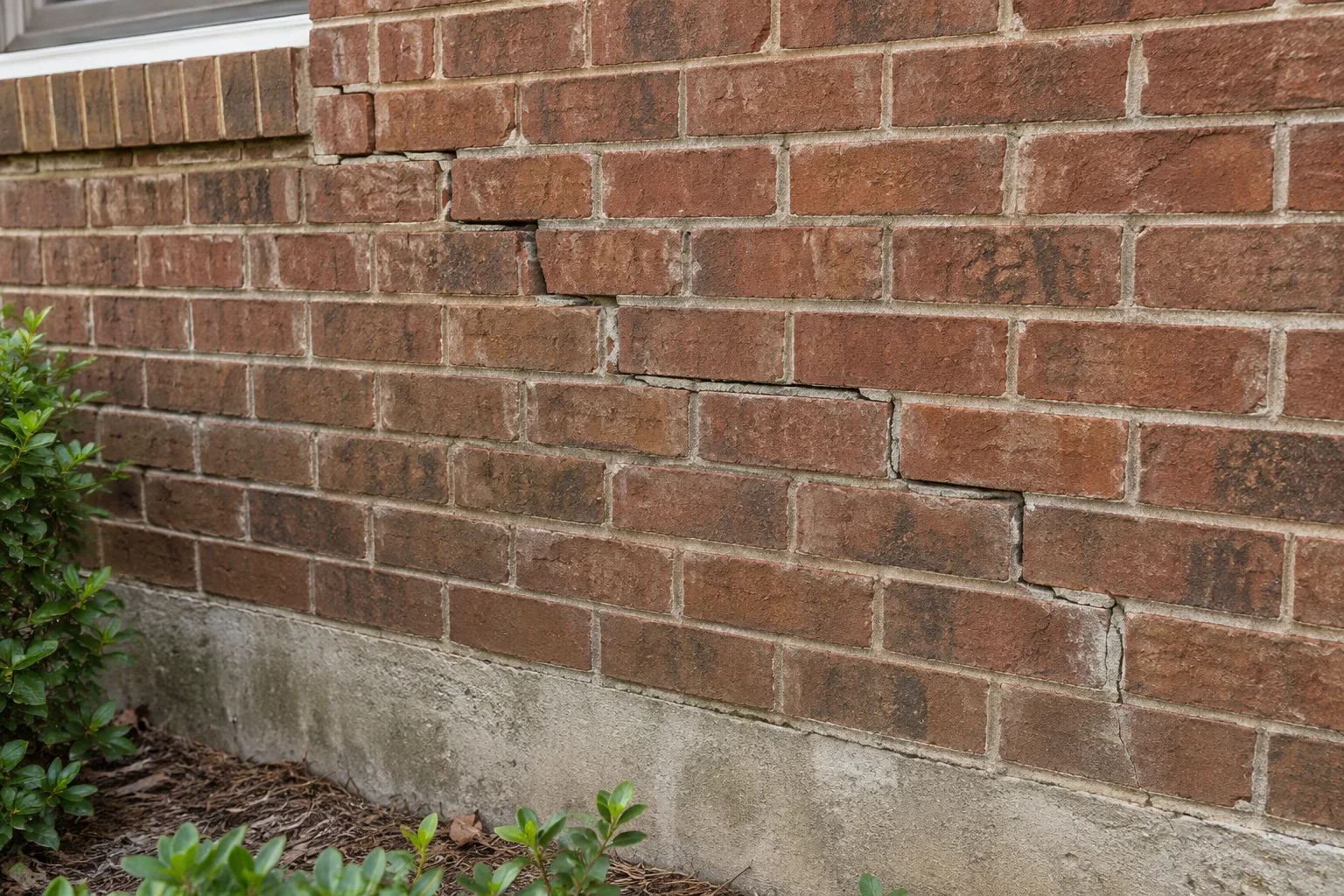
A stair-step crack is not automatically proof that piers are needed. Ask for measurements, alternatives, and the consequence of monitoring before accepting a structural scope.
What should I ask before accepting a quote?
Ask for the contractor's exact legal and licensed identity, insurance proof, written scope, exclusions, warranty terms, payment schedule, and any engineering or permit assumptions. Compare at least two written opinions when the scope is significant, and avoid same-day pressure.
Use the Georgia Secretary of State license verification portal to check the actual licensed individual or qualifying agent, not just a business name. The Georgia Attorney General's home repairs and improvements guidance also recommends written contracts, insurance questions, and care with upfront payments.
Confirm whether the price covers drainage corrections, access, permits, engineering, cleanup, and follow-up measurements. Ask what is excluded and what would trigger a change order.
What happens after an introduction?
The contractor, not this referral service, confirms availability and any assessment fee, visits if you agree, and provides whatever written scope or estimate they promise. You can ask questions, seek another opinion, or decline; there is no signed buyer, exclusive territory, or obligation to hire.
Keep the referral disclosure and the contractor's written terms. If the contractor proposes piers, crack injection, leveling, or waterproofing, ask which observed condition the method addresses and what happens if movement or water continues.
A referral connection remains free to request. Any work, inspection, assessment, engineering, permit, or repair payment is a separate matter between you and the contractor.
Frequently asked questions
Is the referral request free?
Yes. Marietta Foundation Repair does not charge for submitting a referral request. Contractor availability, assessment fees, scope, and schedule are not guaranteed. Confirm them directly before accepting a visit.
Does an introduction mean an inspection is booked?
No. An introduction is not a booked appointment. The contractor must confirm availability, timing, who will attend, and any assessment fee directly with you.
Is a contractor assessment the same as an engineer's report?
No. A contractor may provide observations and a repair estimate, but that is not automatically an independent structural-engineering report. Ask whether a Georgia-licensed professional engineer should review a major structural recommendation.
Do stair-step cracks automatically require piers?
No. They can be a sign of differential movement, but a photograph or symptom alone cannot identify the cause or repair. Ask for measurements, alternatives, and drainage and fill review before accepting a structural scope.
What should I document before a visit?
Photograph cracks with a scale, note their locations and dates, record changes in doors or floors, and note water entry or drainage conditions. Do not disturb structural elements or attempt a structural repair yourself.
How do I check a contractor license?
Ask for the licensed individual or qualifying agent and verify the record through Georgia's official license verification portal. Also ask for current insurance, a written scope, warranty terms, payment schedule, and references you can independently check.