10 Signs You Need Foundation Repair: A Cobb County Homeowner's Guide
Need help with your own home?
Tell us your concern. We'll check local contractor availability.
No referral fee · No obligation to hire
What are the warning signs you need foundation repair?
Cracks, sticking doors or windows, uneven floors, gaps, seepage, chimney movement and nail pops can prompt an assessment. Their significance depends on location, change over time and site evidence. One sign or several together do not by themselves establish foundation movement or select a repair.
This guide explains warning signs and questions to raise during a property assessment; it is not a diagnosis or a survey of Cobb County cases. Marietta Foundation Repair is a referral service, not a contractor. Homeowners may request an introduction, but must confirm any contractor's credentials, availability, scope and fees directly.
A useful habit is to track whether a sign is stable or changing. A hairline crack that has not moved in two years differs from one that widened over a single summer. Seasonal moisture may affect symptoms on some lots, but mapped soil and weather context do not diagnose a property; note changes across time and ask for measurements.
If you recognize several of the signs below, the safe next step is a foundation inspection. To understand the root cause first, read why foundations crack in Cobb County, and for the cracks specifically, see foundation crack repair.
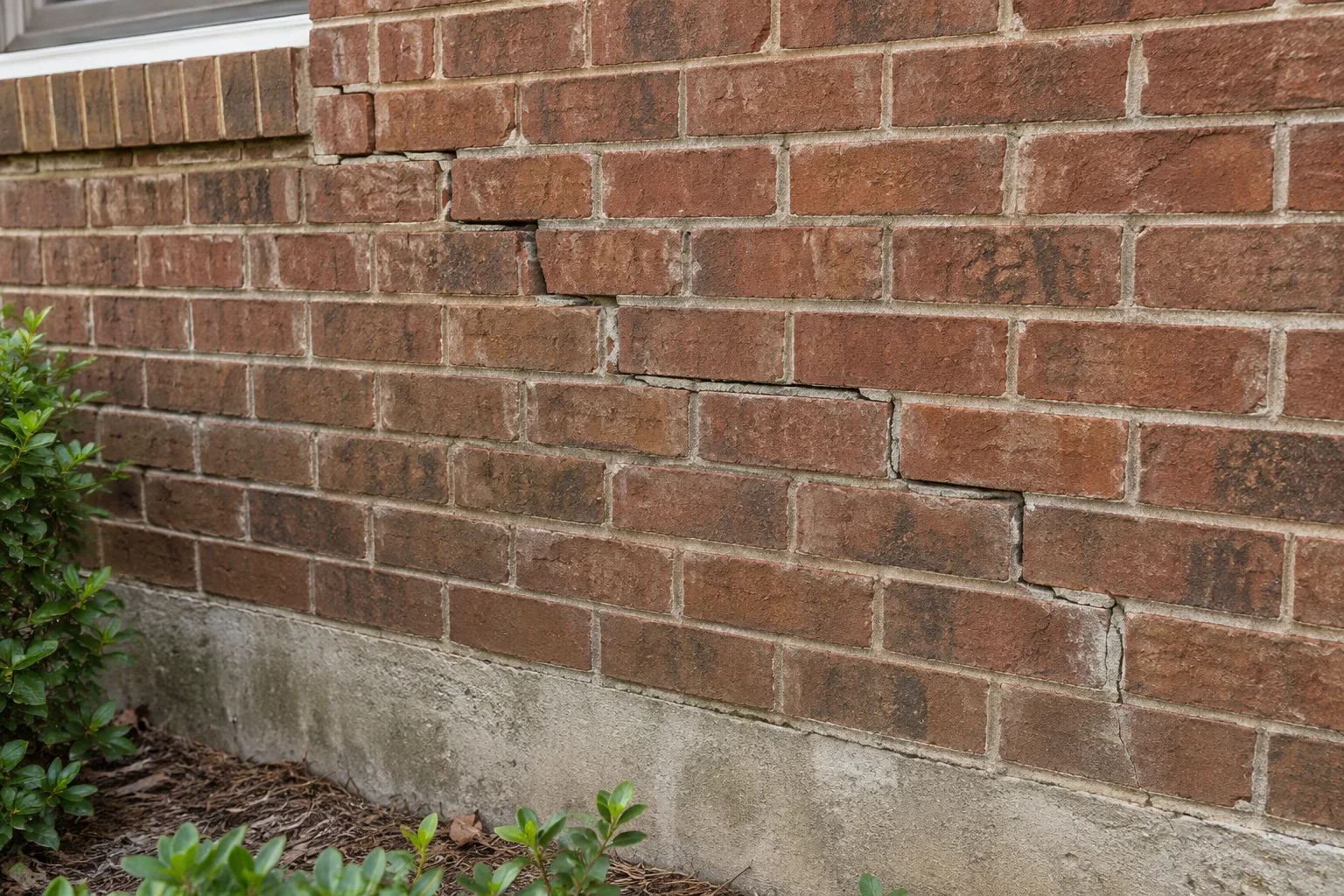
- Stair-step cracks in brick or block veneer
- Doors and windows that stick or won't latch
- Sloping, sagging, or bouncy floors
- Drywall cracks at the corners of doors and windows
- Gaps opening at trim, baseboards, or crown molding
- Basement or crawlspace water seepage and efflorescence
- A chimney pulling away, tilting, or leaning
- Cracked, uneven, or domed slab floors
- Gaps where exterior walls meet the roofline or each other
- Nail pops and popped drywall seams along walls and ceilings
Why do these foundation problems happen in Cobb County, GA?
Marietta and Cobb County contain varied mapped soils, fill, grades, drainage, tree cover, foundation types, and construction histories. Regional rainfall and soil context may help frame questions, but they do not explain every sign. Site evidence is needed to distinguish movement, moisture, framing, masonry, plumbing, and ordinary finish changes.
Warning signs can have several causes, including foundation movement, moisture, framing, masonry, plumbing, or ordinary finish changes. Mapped Piedmont and Cecil soils are regional context rather than a diagnosis. Look for combinations, change over time, displacement, water entry, and effects on doors or floors.
Metro Atlanta receives substantial rain, and seasonal moisture may affect symptoms on some properties. Drought, heavy rain, drainage, roots, fill, and foundation type can influence conditions differently by lot. Record dated changes after wet or dry periods, but do not infer a cause or outcome without site evidence.
Poor gutter or grading drainage is one possible contributor, but water path, foundation type, fill, plumbing, framing, and construction details vary by lot. Slab, basement, crawlspace, and post-tension homes raise different inspection and safety questions; a code reference or housing-era label does not determine a cause or method.
Are stair-step cracks in my brick a sign of foundation problems?
Stair-step cracks follow mortar joints and can reflect differential movement, but the pattern alone does not establish cause or method. Width, displacement, growth, foundation type, drainage, fill, and companion symptoms matter. A widening or displaced crack merits prompt assessment; a stable hairline crack may be monitored with dated photographs.
A stair-step crack follows mortar joints up brick or block in a staircase pattern. It can occur with differential movement, but veneer movement, masonry details, settlement history, and other conditions can look similar. Document the width and change, then ask for site evidence rather than treating the pattern as a diagnosis.
Width, displacement, water entry, location, and change over time are useful observations, but no single width or seasonal pattern diagnoses a property or sets a universal urgency threshold. Photograph the crack with a scale, date it, and seek appropriate advice when it is changing, displaced, associated with safety concerns, or otherwise unclear.
Stair-step cracks paired with sticking doors or sloping floors deserve a professional assessment, but they do not prove that a footing needs stabilization or that piers are the answer. Ask what was measured, what alternatives were considered, and whether monitoring or drainage correction is reasonable.
Why do my doors and windows suddenly stick or won't latch?
Doors and windows that stick, drag, or will not latch can accompany foundation movement, but humidity, framing, hardware, installation, and other causes are also possible. Note which openings changed and when; multiple or worsening changes with other observations warrant site-based assessment rather than a remote soil diagnosis.
An opening can change shape for several reasons, including framing movement, moisture, installation, or hardware. Record which doors or windows are affected, what changed, and whether floors, walls, water, or drainage changed at the same time.
Seasonal timing can provide context, but it does not distinguish soil movement from moisture effects or other causes. Do not infer a diagnosis from the month or a Cobb County address.
Multiple changes or significant worsening warrant appropriate advice. The assessment guide helps you ask about observations, measurements, access, fees, and scope.
What do sloping, sagging, or bouncy floors mean?
Sloping, sagging, or bouncy floors are observations that may involve a slab, supports, framing, moisture, finishes, or construction. Foundation type helps determine what should be inspected, but neither the symptom nor the foundation type alone establishes a shifted support or selects leveling, shimming, framing work, or another method.
Floors reveal conditions beneath or within the floor system, but a slope or bounce can have several causes. On slab homes it may relate to settlement, heave, voids, framing, or construction; on crawlspace homes inspect piers, beams, joists, drainage, and moisture without assuming one cause. A visible or changing slope deserves a prompt look.
On pier-and-beam or crawlspace homes, floor flexibility may relate to piers, beams, joists, moisture, fasteners, finishes, or other conditions. On slab homes, a floor change may relate to settlement, heave, voids, plumbing, framing, or construction. Ask what was measured in the actual floor system.
A provider may discuss support, framing, slab, drainage, monitoring, crack treatment, or another scope after inspection. The foundation type can guide access and questions, but does not remotely determine the cause or repair.
Are drywall cracks at door corners and gaps at trim serious?
Cracks near openings and trim gaps can reflect several conditions. Their pattern or combination does not prove foundation movement. Record changes and ask what property-specific assessment is appropriate.
Openings can influence where cracks appear, but the location does not establish a subsurface cause. Framing, finishes, moisture and structural conditions may need consideration.
Gaps at trim and baseboards can accompany movement, moisture, framing changes, or finish work. Photograph the gap, note when it appeared, and compare it with floor, door, wall, and drainage changes before drawing a structural conclusion.
Document the location and changes in cracks, doors and trim. The foundation-crack guide and assessment guide help prepare questions; they do not diagnose movement or book an inspection.
How should I respond to chimney movement or seepage?
A tilting chimney, wall displacement, sudden changes, or active water can warrant prompt professional attention, but a webpage cannot classify every symptom as an emergency. Keep clear of an immediate hazard and contact appropriate emergency or professional help; otherwise document the condition and ask for a site-based assessment.
A chimney that is separating, leaning, or changing can create a safety concern and should not be approached if unstable. The observation does not by itself establish the footing condition or required repair.
Basement or crawlspace seepage — water stains, a musty smell, white powdery efflorescence on the walls, or pooling after a storm — can warrant prompt review. Standing water can damage crawlspace materials and increase moisture against basement walls. A contractor should trace the water path and assess any wall movement rather than assume a cause.
Wall movement, water entry and a separating chimney need appropriate evaluation. Wall reinforcement, water management and deep support are different options, not automatic responses to those symptoms.
How should I prioritize foundation warning signs?
Use change, displacement, water, and safety context to decide what deserves prompt attention, but do not diagnose urgency or cause remotely. If there may be an immediate hazard, keep clear and seek appropriate emergency or professional help; otherwise document observations and ask for an assessment.
For planning, separate immediate-safety concerns from conditions that can be documented while awaiting advice. A wall, chimney, floor, crack, or water symptom that is sudden, changing, displaced, or unsafe deserves prompt attention; a stable cosmetic observation may be documented, but its cause still is not established.
For signs you plan to monitor, photograph them, mark crack ends with a date, and note changes after wet or dry periods. A change over time is useful evidence, but it still does not identify the cause without a site assessment.
- Seek prompt help: sudden movement, visible instability, significant displacement, active water creating a hazard, or uncertainty about safety
- Document and monitor while arranging advice when appropriate: stable hairline or finish changes without displacement or an immediate hazard
- For either category, photograph and date observations, keep clear of unsafe areas, and confirm any assessment scope and fee directly
How much does foundation repair cost once a sign is confirmed?
The safest next step is to document what changed and ask a qualified professional to assess the property. This referral service may check local contractor availability; any visit, fee, diagnosis, scope, and schedule are confirmed directly with the contractor.
Walk the property, photograph and date changes, and note moisture or seasonal timing as context only. Wet or dry periods do not establish a clay mechanism, progression, or repair; ask what will be measured during any available assessment.
By method, published ranges include roughly $300–$3,000 for crack injection, $1,400–$3,500 per pier for helical or push systems, $600–$2,500 for slab leveling, $350–$1,000 per carbon-fiber strap, $1,750–$6,000 for some bowing-wall scopes, $2,000–$10,000 for some waterproofing scopes, and $5,000–$12,000 for some encapsulation scopes. These figures are rough budgeting context, not verified Cobb County price data or a contractor quote.
Use the foundation cost estimator for rough planning, then start with an assessment if available. Marietta Foundation Repair is a referral service: the referral request has no fee from this service, while any contractor assessment fee and terms are confirmed directly.
What should I do next if I see these foundation warning signs?
Document what changed, photograph and date cracks, and request a site assessment if one is available. This referral service may check contractor availability, but does not inspect, diagnose, quote, or repair. Confirm identity, credentials, assessment fee, scope, and schedule directly with any contractor.
Document visible changes only where you can do so safely: photograph and date observations, and record any change you notice without disturbing the structure. Seasonal timing is useful context, but does not establish the soil type or movement mechanism. Do not enter an unsafe area or delay urgent help to complete a checklist.
Then request an assessment if available. Ask what will be measured, what evidence supports the proposed method, and whether an independent engineer should review a substantial structural proposal.
Marietta Foundation Repair may check whether a suitable contractor is available in Marietta, East Cobb, Smyrna, Kennesaw, Acworth, and Powder Springs. We do not promise a single provider, diagnosis, credentials, inspection, or outcome. Start with why foundations crack in Cobb County or an assessment request.
Frequently asked questions
What foundation signs should I document?
Stair-step brick cracks and sticking doors are useful signs to document, but neither proves a diagnosis. Look for change, displacement, sloping floors, trim gaps, water, or multiple symptoms, then seek a site assessment.
How do I know if a foundation crack is serious or cosmetic?
A crack's appearance, width, direction, or seasonal change may be useful to document, but none alone establishes whether it is cosmetic, structural, active, or urgent. Photograph it with a scale, note dates and displacement or water, and seek a site-based assessment if it changes or raises safety concerns.
Why do my foundation signs get worse in late summer and fall?
Symptoms may worsen during dry or wet periods on some properties, but the timing and cause vary by soil, drainage, foundation, and construction. Record dated changes and request measurements rather than assuming a regional cycle.
Which foundation warning signs are emergencies?
Sudden movement, visible instability, significant displacement, active water creating a hazard, or uncertainty about safety warrants prompt attention. Keep clear of an immediate hazard and contact appropriate emergency or professional help. Stable cosmetic observations can be documented while arranging advice, but no symptom list can classify every property remotely.
Does seeing these signs mean I definitely need expensive repairs?
No. Warning signs justify documentation and assessment if available, not a guaranteed expensive repair. Some are cosmetic or moisture-related; if repair is proposed, compare the evidence, scope, alternatives, and rough budgeting context directly.
Does Marietta Foundation Repair inspect my home itself?
No. Marietta Foundation Repair is a disclosed referral service, not a contractor. We may check whether a suitable contractor is available; verify credentials and assessment terms directly. The referral request has no fee from this service.